Sunday, August 28, 2016

salam

حضرت ابوذر رضی اللہ تعالیٰ عنہ سے روایت ہے کہ رسول اللہ صلی اللہ علیہ وآلہ وسلم نے فرمایا جس نے اجازت ملنے سے پہلے پردہ اٹھا کر کسی کے گھر میں نظر ڈالی گویا کہ اس نے گھر کی چھپی ہوئی چیز دیکھ لی اور اس نے ایسا کام کیا جو اس کے لئے حلال نہیں تھا۔ پھر اگر اندر جھانکتے وقت سامنے کوئی اس کی آنکھیں پھوڑ دیتا تو میں اس پر کچھ نہ کہتا (یعنی بدلہ نہ دلاتا) اور اگر کوئی شخص کسی ایسے دروازے کے سامنے گزرا جس پر پردہ نہیں تھا اور وہ بند بھی نہیں تھا پھر اس کی گھر والوں پر نظر پڑ گئی تو اس میں اس کی کوئی غلطی نہیں بلکہ گھر والوں کی غلطی ہے۔
عَنْ أَبِي ذَرٍّ قَالَ قَالَ رَسُولُ اللَّهِ صَلَّی اللَّهُ عَلَيْهِ وَسَلَّمَ مَنْ کَشَفَ سِتْرًا فَأَدْخَلَ بَصَرَهُ فِي الْبَيْتِ قَبْلَ أَنْ يُؤْذَنَ لَهُ فَرَأَی عَوْرَةَ أَهْلِهِ فَقَدْ أَتَی حَدًّا لَا يَحِلُّ لَهُ أَنْ يَأْتِيَهُ لَوْ أَنَّهُ حِينَ أَدْخَلَ بَصَرَهُ اسْتَقْبَلَهُ رَجُلٌ فَفَقَأَ عَيْنَيْهِ مَا عَيَّرْتُ عَلَيْهِ وَإِنْ مَرَّ الرَّجُلُ عَلَی بَابٍ لَا سِتْرَ لَهُ غَيْرِ مُغْلَقٍ فَنَظَرَ فَلَا خَطِيئَةَ عَلَيْهِ إِنَّمَا الْخَطِيئَةُ عَلَی أَهْلِ الْبَيْتِ

Friday, August 26, 2016

بچوں کو سلام کرنا

حضرت سیار فرماتے ہیں کہ میں ثابت بنانی کے ساتھ جا رہا تھا کہ بچوں پر گزر ہوا تو انہوں نے بچوں کو #سلام کیا اور فرمایا کہ میں حضرت انس رضی اللہ تعالیٰ عنہ کے ساتھ تھا آپ بچوں کے پاس سے گزرے تو ان کو سلام کیا اور فرمایا کہ میں نبی اکرم صلی اللہ علیہ وآلہ وسلم کے ساتھ تھا جب آپ صلی اللہ علیہ وآلہ وسلم #بچوں کے پاس سے گزرے تو آپ صلی اللہ علیہ وآلہ وسلم نے بچوں کو سلام کیا۔
عَنْ سَيَّارٍ قَالَ کُنْتُ أَمْشِي مَعَ ثَابِتٍ الْبُنَانِيِّ فَمَرَّ عَلَی صِبْيَانٍ فَسَلَّمَ عَلَيْهِمْ فَقَالَ ثَابِتٌ کُنْتُ مَعَ أَنَسٍ فَمَرَّ عَلَی صِبْيَانٍ فَسَلَّمَ عَلَيْهِمْ وَقَالَ أَنَسٌ کُنْتُ مَعَ رَسُولِ اللَّهِ صَلَّی اللَّهُ عَلَيْهِ وَسَلَّمَ فَمَرَّ عَلَی صِبْيَانٍ فَسَلَّمَ عَلَيْهِمْ 
جامع #ترمذی ۔ جلد دوم ۔ #حدیث 607

Thursday, August 25, 2016

Mu’adh ibn Anas reported: The Prophet, peace and blessings be upon him, said, “Whoever recites the chapter ten times completely: He is Allah, the One(112:1), then Allah will build a palace for him in Paradise.”
Source: Musnad Ahmad 15183
Grade: Sahih (authentic) according to Al-Albani
عَنْ مُعَاذِ بْنِ أَنَسٍ الْجُهَنِيِّ عَنْ النَّبِيِّ صَلَّى اللَّهُ عَلَيْهِ وَسَلَّمَ قَالَ مَنْ قَرَأَ قُلْ هُوَ اللَّهُ أَحَدٌ حَتَّى يَخْتِمَهَا عَشْرَ مَرَّاتٍ بَنَى اللَّهُ لَهُ قَصْرًا فِي الْجَنَّةِ
15183 مسند أحمد مُسْنَدُ الْمَكِّيِّينَ
6472 المحدث الألباني خلاصة حكم المحدث صحيح في صحيح الجامع
Abdullah ibn Mas’ud reported: We were sitting with the Prophet, peace and blessings be upon him, when a man stood to leave. Another man spoke badly about him after he left, so the Prophet said, “Pick your teeth.” The man said, “O Messenger of Allah, why should I pick my teeth when I have not eaten meat?” The Prophet said, “You have eaten the flesh of your brother.”
Source: al-Mu’jam al-Kabīr 9951
Grade: Sahih (authentic) according to Al-Haythami
عَنْ عَبْدِ اللَّهِ قَالَ كُنَّا جُلُوسًا عِنْدَ النَّبِيِّ صَلَّى اللَّهُ عَلَيْهِ وَسَلَّمَ فَقَامَ رَجُلٌ فَوَقَعَ فِيهِ رَجُلٌ مِنْ بَعْدِهِ فَقَالَ النَّبِيُّ صَلَّى اللَّهُ عَلَيْهِ وَسَلَّمَ تَخَلَّلْقَالَ وَمَا أَتَخَلَّلُ يَا رَسُولَ اللَّهِ أَكَلْتُ لَحْمًا قَالَ إِنَّكَ أَكَلْتَ لَحْمَ أَخِيكَ
9951 المعجم الكبير للطبراني باب التاء طرق حديث عبد الله بن مسعود
8/97 المحدث الهيثمي خلاصة حكم المحدث رجاله رجال الصحيح في مجمع الزوائد

Tuesday, August 23, 2016

Abu Huraira reported: The Messenger of Allah, peace and blessings be upon him, said, “Once there was a prophet who was resting under a tree when an ant bit him, so he ordered that his luggage be taken away and the ant’s dwelling burned with fire. Allah revealed to him: Was one ant not enough?”
In another narration, the Prophet said, “Allah revealed to him: A single ant has bitten you, yet you have destroyed a nation that glorifies Allah?”
Source: Sahih Bukhari 3141, Sahih Muslim 2241
Grade: Muttafaqun Alayhi (authenticity agreed upon) according to Al-Bukhari and Muslim
عَنْ أَبِي هُرَيْرَةَ رَضِيَ اللَّهُ عَنْهُ أَنَّ رَسُولَ اللَّهِ صَلَّى اللَّهُ عَلَيْهِ وَسَلَّمَ قَالَ نَزَلَ نَبِيٌّ مِنْ الْأَنْبِيَاءِ تَحْتَ شَجَرَةٍ فَلَدَغَتْهُ نَمْلَةٌ فَأَمَرَ بِجَهَازِهِ فَأُخْرِجَ مِنْ تَحْتِهَا ثُمَّ أَمَرَ بِبَيْتِهَا فَأُحْرِقَ بِالنَّارِ فَأَوْحَى اللَّهُ إِلَيْهِ فَهَلَّا نَمْلَةً وَاحِدَةً
وفي رواية أخرى قال فَأَوْحَى اللَّهُ إِلَيْهِ أَفِي أَنْ قَرَصَتْكَ نَمْلَةٌ أَهْلَكْتَ أُمَّةً مِنْ الْأُمَمِ تُسَبِّحُ
3141 صحيح البخاري كتاب بدء الخلق باب خمس من الدواب فواسق يقتلن في الحرم
2241 صحيح مسلم كتاب السلام باب النهي عن قتل النمل
Narrated 'Abdullah bin Umar (Radi-Allahu 'anhu):

Once the Prophet (Sallallahu 'Alaihi Wa Sallam) sent to 'Umar a silken
two-piece garment, and when he saw 'Umar wearing it, he said to him, "I
have not sent it to you to wear. It is worn by him who has no share in the
Hereafter, and I have sent it to you so that you could benefit by it (i.e.
sell it)."

Bukhari Vol. 3 : No. 317

Friday, August 19, 2016

Sunan al-Tirmidhī 3358

Abu Huraira reported: The Messenger of Allah, peace and blessings be upon him, said, “Verily, the first thing a servant will be asked about on the Day of Resurrection will be his blessings. It will be said to him: Did We not give you health in your body and cool water to drink?”
Source: Sunan al-Tirmidhī 3358
Grade: Sahih (authentic) according to Al-Albani
عَنْ أَبِي هُرَيْرَةَ قَالَ قَالَ رَسُولُ اللَّهِ صَلَّى اللَّهُ عَلَيْهِ وَسَلَّمَ إِنَّ أَوَّلَ مَا يُسْأَلُ عَنْهُ يَوْمَ الْقِيَامَةِ يَعْنِي الْعَبْدَ مِنْ النَّعِيمِ أَنْ يُقَالَ لَهُ أَلَمْ نُصِحَّ لَكَ جِسْمَكَ وَنُرْوِيَكَ مِنْ الْمَاءِ الْبَارِدِ
3358 سنن الترمذي كتاب تفسير القرآن باب ومن سورة ألهاكم التكاثر
3358 المحدث الألباني خلاصة حكم المحدث صحيح في صحيح الترمذي

Thursday, August 18, 2016

Bukhari Vol. 3 : No. 576

Narrated Hudhaifa (Radi-Allahu 'anhu):

I heard the Prophet (Sallallahu 'Alaihi Wa Sallam) saying, "Once a man died
and was asked, 'What did you use to say (or do) (in your life time)?' He
replied, 'I was a business-man and used to give time to the rich to repay
his debt and (used to) deduct part of the debt of the poor.' So he was
forgiven (his sins.)" Abu Masud said, "I heard the same (Hadith) from the
Prophet."

Bukhari Vol. 3 : No. 576

The Contradictions In Western Idea Of Freedom Of Speech And The Islamic Perspective


The primary source of #information that the #people of West have for gaining information about Islam is Western media. Both the print and electronic media of West is what provides information to the people about Islam and it is the #biasness of this media that the people of the West have a negative perception of Islam and they see it as a religion of oppression and #aggression.

One of the major things that Islam is accused of in the Western world is the oppression of freedom of speech. West proclaims to be the proponent and the emblem bearer of freedom of speech, whereas it regards Islam as a religion where the followers have no say whatsoever and they cannot raise their voice against anything.

Islamic-prespective-and-freedom-of-speech copy

The Islamic opinion about the freedom of speech will be discussed in later part of the writing however, the thing that needs to be addressed first is the Western view of freedom of speech and how it contradicts with it.

Western View:

The West is the proponent of freedom of speech where the individuals in a society are free to express their opinion in any way they want against or for anyone they want. Although this type of freedom cannot exist in world because such a freedom would result in nothing but people defaming each other, spreading slanders and falsely accusing each other. Therefore, in the Western law, despite all the freedom, the limit of it is set that it does not result in hurting the feeling of anyone or that harms the image of some other person.

Contradiction:

The West speaks of freedom of speech without any boundaries, however, it shows biasness towards certain matters and for them it has made laws, whereas, when it comes to other social systems in the world like Islam, they judge it and defame it for the limits it has put on its followers. Some major contradiction of the West pertaining to the freedom of speech it so claims are as follows:

Firstly, in the European countries there is a law as per which no one is allowed to speak about ant-Semitic movement in the Nazi regime. People are not allowed to favor the haulocast or give any opinion that does not oppose it. This shows the biasness of the Western media and the demolishing of the notion of freedom of speech. On the other hand, when it comes to Western media publishing the caricature of Prophet Muhammad (PBUH) and Muslims protesting against it, it is simply remarked as a #freedom of expression. Thus, duality and contradiction exist in the Western notion of freedom of speech.
Secondly, in CIA all the employees are bound to sign a document as per which they are never to share or to publish their experience that involves information related to country. This law was passed when CIA officials started writing memoirs regarding their experience during service. Although that was their expression however, it did not fit the US objective therefore, it was taken away from the officials. Thus, another contradiction in Western saying and doing.
Thirdly, in UK as well the officials of the secret agency are not allowed to discuss or publish any information pertaining to national security. Hence, their freedom of speech is also made limited.
The above arguments show that the West speaks of freedom of speech without any constraints, however, when it comes to certain matters and issue, there is no freedom of speech whatsoever and there are strict limitations.

Islamic Perspective:

#Islam is a #religion of moderation and human connection. It does not allow anything that is extreme or that tarnishes the human connection. Islam allows its followers to speak freely and in some cases it stresses upon them to speak without any fear, however, when it comes to speech hurting the feelings or beliefs of someone, Islam tells it followers to refrain from it and adopt a way that is more subtle. Some examples of how Islam views freedom of speech and to what extent does it allows Muslims to proclaim their opinion are as follows:

Prophet Muhammad (PBUH) said in a hadith:

“The master of martyrs is Hamza bin Abdul Muttalib and a man who stood up to an oppressive ruler, ordered him (to do good) and forbade him (from doing evil) and was killed by him.”

The #hadith shows that when it comes to #speaking freely, the allowed speech is that which encourages or promotes goodness and that forbids evil. Therefore, Muslims are to raise their voices without any fear if they see anything bad happening and they should also encourage or support goodness with their voice.

Harun-ul-Rashid was one of the #Muslim caliphs who rewarded scholars who would go out and spread the message of Islam and give people an understanding of deen. Therefore, speech for the sake of spreading of knowledge is also allowed and encouraged in Islam.

Thirdly, on contrary to the Western world where freedom of speech is allowed when it comes to hurting the feelings of the Muslims, Islam forbids any act that hurts the feeling of the non-Muslims living in the Muslims reign. Regarding this, #Prophet Muhammad (PBUH) said in one of His hadiths:

“Whoever hurts a non-Muslim citizen of an Islamic state hurts me, and he who hurts me annoys Allah.” (Bukhari )

From the hadith it is clear that in Islam any proclamation of speech that is against any religion or that hurts the feeling of a non-Muslim is not allowed in Islam. Therefore, the notion that Islam or Muslims somehow are in opposition of non-Muslims or they go to any measures to defame other religions is wrong, rather Islam wants Muslims to accept that other people have their religion and there is no need of turning towards hurtful speech as a means of spreading Islam.

Conclusion:

Ina nutshell, there is no such thing as an ideal freedom of speech in the world and if West does preach any it is limited and wherever it conflicts with the great scheme the right of speech is taken back from the respective people. Islam encourages a speech that is in favor of good and that detests bad, however, even then the speech is supposed to be free from any hate and resentfulness.
#online #teaching

Monday, August 15, 2016

Islamic & Quranic Moral Values Muslims Must Follow

Morality or the propagation of moral values is a major aspect of Islam. People of today think of Quran as only a Book that contains guidelines that are pertinent to performing of religious rituals only and there is nothing else in it. The fact of the matter is that in #Quran Allah Almighty has given the complete guidelines and told humanity about whatever they want to know about this universe in general and the way of living life in particular.
Islamic-Moral-Values copy
Islam puts great emphasis on the height of characters and for this purpose it encourages the followers to adopt good moral qualities in their lives. In this regard, the life of Prophet Muhammad (PBUH) stands as an evident and clear example for Muslims and from him they can learn what the height of moral is like. In Quran, there are mentions of numerous moral values that a Muslim should incorporate in his or her character. The lines below discuss a few of such major moral values.
Quranic Moral values
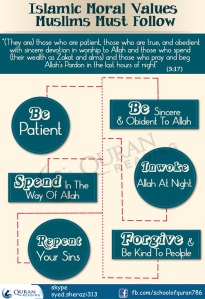
“(They are) those who are patient, those who are true, and obedient with sincere devotion in worship to Allah and those who spend (their wealth as Zakat and alms) and those who pray and beg Allah’s Pardon in the last hours of night.” (3:17)
This ayah highlights the multiple characteristics of a believer. These characteristics are:
  1. First comes patient. A believer is to have the quality of patience in his character because it is the quality that comes in handy in almost every aspect of life. When one is patient, only then he endures the hardships of life without losing faith, it is with patience that he develops good relations with others and it is with patience that he bears the ease and comfort of others before himself.
  2. Second comes the moral value of sincere and obedient worship of Allah. Being a Muslim a person ought to worship Allah Almighty and the five times a day prayers are an obligationas well, however, people consider prayers or any form of worship as a duty and perform it mechanically. Whereas, the ayah focuses on worshiping Allah with sincerity and obedience, therefore, one needs to incorporate this spirit of devotion in the worshiping of Allah.
  3. Third is the moral value of spending from the wealth in the name of Allah. Zakat is an obligation upon Muslims who are wealthy, however, charity or alms giving is something which everyone can do, especially the ones who have enough to give but not enough to offer in Zakat. Therefore, being charitable is a moral value that Muslims need to merge in their character.
  4. Fourth comes the praying to Allah in the late hours of night. It is called the Tahajud prayer. The reason why it is one of the moral values that a Muslim should adopt is the fact that firstly, this prayer is in addition to the obligatory prayer, therefore, it shows the additional love of a Muslim to Allah. secondly, this prayer is done in the later part of night in isolation, which takes away all the aspect boastfulness or showiness that can be present in offering of obligatory prayers.
In the same Surah at another place, Allah Almighty mentions a few other moral qualities in the following way:
Muslim Follow moral values
Islamic and moral values
quranic moral values must follow muslims
“And hasten to forgiveness from your Lord and for Paradise as wide as the heavens and the earth, prepared for the pious. Those who spend (in the cause of Allah) in prosperity and adversity, who restrain anger and who pardon the people, and Allah loves doers of good. And those who, when they commit any sexual immorality or wrong themselves (by transgression) remember Allah and ask forgiveness for their sins and who can forgive sins except Allah? And (those who) do not persist in what they have done while they know.”(3:133-135)
Multiple moral attributes are highlighted in these ayahs as well. The moral values that can be inferred from these ayahs are as follows:
  1. Spending in the name of Allah in the condition of adversity as well as in the condition of prosperity is something that a Muslim should develop in his character. There are people who spend in the name of Allah when they are experiencing prosperity, but they cease to do so as soon as they face even the slightest of adverse situations. Therefore, a Muslim must try to be charitable in every situation.
  2. Rage or anger is something that eats up a person as well as his character. Anger is a great vice because it clouds the judgment of a person making him unable to differentiate between right and wrong. Therefore, a Muslim must try to control his temper and rage is a quality that should not be a part of the character of a Muslim.
  3. Forgiving people is another personality attribute that a Muslim must possess. Islam gives the message of being good and kind towards people – forgiving them is one of such acts of kindness. Therefore, keeping grudges and not forgiving people for their mistakes is not something which a Muslim should breed in his character, rather he should be forgiving towards the people.
  4. Besides the other moral qualities, a Muslim needs to be a good-doer on a generic level. The constituent of a good-doer could be numerous, but in simple terms it is the inclination towards doing good things. Therefore, the believer needs to have a mindset that is inclined towards goodness, which produces thoughts of goodness that then trigger acts of goodness.
  5. All humans are fallable and among the different mistakes we commit, the mistakes or sins of sexual nature are more common. The ayah shows that if a person commits some act of sexual nature, then he or she should immediately repent upon it in front of Allah Almighty. Therefore, repentance upon sins is another moral value that a Muslim needs to ensure in his character.
Lastly, the realization that what one has done is wrong is another moral value that should be appreciated in a Muslim. Usually, if people commit some sin, they start to justify it or remain persistent in doing it instead of realizing that they have committed something wrong. A Muslim needs to have a character in which he acknowledges whenever he commits any mistake.
In short, a Muslim has to work upon his moral character. The better values a Muslim incorporates in his character, a better and practicing Muslim he becomes and it is on the basis of this moralist practice of Islam that he will be among the blessed ones, both in this world and in the world Hereafter.

adfly

Listen to Quran

TvQuran