Monday, May 2, 2016

Muslim Husband – Leader of The House

Muslim Husband – Leader of The House
In the recent past, there have been many researches on productivity and efficiency of people, mostly in the workplace, like being proactive, seeking cooperation with others, prioritizing matters, listening carefully, careful planning etc. All of these are good things to keep in mind for one`s success in all walks of life.
Talking about accomplishment in one`s affairs, marriage is a very important concern in a Muslim`s life. It is a great blessing of Allah SWT, which is a relationship of love, understanding and cooperation. But nowadays, many families are facing problems, which could be result of a husband or a wife. As, former is the leader of the house, so it demands greater sense of responsibility from him.
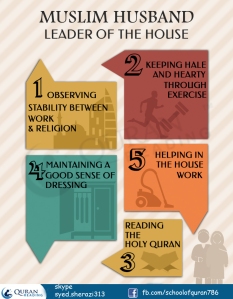
Effective-Muslim-Husband copy
There are certain things which one can adopt in its daily routine to become a highly effective Muslim husband:
Observing Stability Between Work And Religion
Work-life balance has become the hottest issue in today`s organizations. Employees are becoming more and more barren in their occupation because they face serious problems maintaining equilibrium between their private and vocational issues. If they incline towards one side more than what is required, they move towards failure in either issue. So, to avoid this discrepancy, companies have devised systems whereby they ensure that their workers are highly motivated and remain stress free in their work.
Likewise, the head of the Muslim family also has to go through such problems; some have to go on long business tours, while others are stuck in the traumas of their office job deadlines. Such matters result in serious predicaments in one`s marital life. One cannot focus on the needs of its wife and children as it should, mainly because of lack of time to look after them. For perfect remedy of this quandary, one needs to have a proper balance between its work and religion first. Islam is a complete code of life and it contains many religious practices, which in turn helps in leading productive life, like daily prayers teach how to manage one`s time, and Zakah (charity) educates lessening desire for materialistic possessions. Through time management, one could learn how to make it up to one`s family appropriately. And by having lesser wish for earning excessively, one could think about its relations more and fulfill their rights rightfully. So, one should practice its religious obligations as much as it can so that it can benefit from their effectual repercussions.
Keeping Hale And Hearty Through Exercise
Many of the family issues are a result of poor health of the leader of the house. A husband is the heart and brain of the household, who should remain fully efficient so that other affiliates of the home could be happy and satisfied, just like body functions of a man depends on the effective working of one`s soul and mind.
Health problems could easily be solved through regular exercise in the morning and in evening. It does not necessarily means to run for some time in the park. One could also take its wife and children to a nearby recreational area to freshen the mind and body from daily life hassles. This practice also helps in keeping away from carrying diseases like overweight, heart and tissue problems. As, health is wealth, and for any Muslim man, its family should be the utmost priority, so one should always try to remain at the best of its physical condition in order to give its best to family members.
Reading The Holy Quran
The Sacred Scripture of Quran contains all the necessary information for living a successful life, as it not only highlights the great importance of religious duties but also gives much insight about many social and family issues of privileges and duties. A Muslim husband has to set the perfect leading example in one`s home, so by reading and understanding Holy Quran, his children could learn from him and gain inspiration to learn Quran themselves. Moreover, he can also teach his wife about her responsibilities, and learn about his own family obligations to work effectively for their fulfillment.
Maintaining A Good Sense Of Dressing
The modern and Islamic concept of nice clothing does not go along hand in hand. The former is more inclined towards materialism and demands expensive dressing, but the latter just requires a Muslim to remain in complete state of cleanliness with respect to its body and garments no matter how much the dress is simple.
A Muslim husband also needs to act upon the very Sunnah of the Holy Prophet (PBUH), and keep wearing neat and tidy clothes, so that he can act as the perfect example for his kids and spouse in sanitation.
Helping In The House Work
There is a great misconception in today`s society that the female has to look after all the in-family affairs from cooking meals till taking care of kids. That is not the correct gist of Islamic ideologies, nor is the way of the Prophet Muhammad`s (PBUH) life, Who not only used to do His private tasks Himself, but also was observed greatly involved in carrying out daily household work.
Aisha (Ra) once said about Muhammad (PBUH):
“Allah’s Messenger (peace be upon him) used to patch his sandals, sew his garment and conduct himself at home as anyone of you does in his house. He was a human being, searching his garment for lice, milking his sheep, and doing his own chores.” (Tirmidhi)
How many men in this day and age mend their worn out dresses and shoes themselves and share the burden of their wives in house job. There is a great parable in the life of the Holy Prophet (PBUH) for each and every one of us, Who did all the apparently looking pity things Himself and was not burdening them over others` shoulders. So, it’s clear that a Muslim husband should not feel shame in taking part in internal work of family like helping out wife in making meals, and other stuff like that so that his wife could feel comforted and cared.
So, to conclude, we can say that nobody can be ever perfect, and things are not always as pleasant in relations as one wants them to be. But, to be closer to an ideal Muslim husband, one should at least take care of its basic responsibilities like looking after his own affairs and other family members, gaining and spreading the necessary Islamic insight, actively taking part in family matters, and above all, one should act as a role model for others in every respect.

Wednesday, April 27, 2016

9 Benefits Of Reciting Quran With Translation

The Holy Quran is the 4th and Last Sacred Book of Allah SWT that He revealed upon His Last Messenger, Hazrat Muhammad ﷺ in the early 7th century A.D. It not only approves the previous Heavenly Manuscripts of the Almighty and His Prophets, but also provides a complete guideline for living a successful life here and in the hereafter. Muslims all over the world recite and understand this Sanctified Scripture as a religious duty and seek assistance from it. The Creator of the world of the worlds says regarding the matter of understanding the Instructions present in Furqan e Hameed as:
recite quran
“So when the Qur’an is recited, then listen to it and pay attention that you may receive mercy.” [Quran, 7: 204]
The Holy Quran was first disclosed in the land of Arabia and its official language too is Arabic, but still God, the Exalted has emphasized on listening to its recitation closely in order to comprehend its true connotation. If the native Arabians were directed to do so, it means that those who do not know this mode of communication better, they are even more required to translate its teachings into their local speech to absorb it better.
Although, the plain recital might well lead to obtaining some benefits in terms of Allah`s Remembrance and seeking His forgiveness, but that is only possible when someone has already read or understood some of the essential teachings of Furqan e Hameed before. In case of new learners, it is only likely to get some advantage out of narration of this Consecrated Paperback when it is done in a language that it can easily understand.
Holy-Quran-Reading-Benefits copy
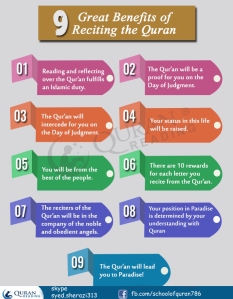
Some of the great benefits of reading the Holy Quran with Translation (Understanding) are as follows:
More Reward For Non Arabic Natives
If this Revered Volume of Allah SWT was just meant for plain recitation without understanding it, then it would not be possible for the rest of the world to realize its actual connotation. There is a great reward for reading the Holy Quran especially in case of Arabic being a foreign language, as it ultimately leads to attainment of Knowledge of the commandments of the Almighty Lord.
Hazrat Abdullah ibn Ma’sood (R.A) narrates that Rasulullah ﷺsaid:
“Those who attempt to read it with difficulty (because of their lack of familiarity with the language) will merit double rewards.” (Tirmidhi and Abu Dawood)
The above mentioned Hadith tells about tremendous amount of returns in the form of blessings of Allah SWT as a result of having difficulty in the Quranic recital. It means that those who do not understand the Arabic language, yet they strive hard to learn about teachings of Furqan e Hameed, it will be considered a bigger effort for sake of pleasing the Gracious God.
In-Depth Reading Leading To More Understanding
It is common observation in any field of studies that comprehensive analysis of things leads to better understanding of the complex matters and concepts involved under consideration. Arabic too is a very intricate and hard to grasp lingo that calls for translation of the Holy Verses of Quran into some native language in order to be aware of them properly.
Hazrat Abu Sa’eed Khudri (R.A) narrates that Rasulullah PBUH said:
‘That person who, due to excessive recitation of the Qur’an is not able to make Allah Ta’ala’s Dhikr and Du’a, Allah Ta’ala will bestow such a person with more blessings and Ni’mat than even those who make Dhikr and Du’a.’ (Tirmidhi)
It means that a person who thoroughly reads Furqan e Hameed so that it could make itself familiar with the Islamic Convictions attains more bounties of Allah SWT as compared to spending that extra time in His Memory. This is so because while doing detailed study of the Quranic Revelations, one comes to know about its true significance which helps a person to put its life on the right track.
Knowing About Matters Concerning Daily Life
The Holy Quran does not just comprise of parables about the past nations, but also encloses life transforming instructions and guidelines from the Gracious God.
quran translation n recitation
“And, We have certainly presented for the people in this Qur’an from every [kind of] example – that they might remember.” [Quran, 39: 27]
The above mentioned Ayah clearly indicates that this Sacred Book consists of such examples which are very crucial for one to remember in order to seek constant guidance.
No! Indeed, the Qur’an is a reminder. Then whoever wills will remember it. [Quran, 74: 54-55]
If Quran is a reminder, then how can one come to know about Warnings and Prompts discussed by Allah SWT if a person does not understand the Arabic language? It increases the significance of translation of the Hallowed Verses so that one can recognize the essential directives and commands of the Almighty Lord.
Fulfillment of a Religious Duty
The demise of the Muslims in this day and age is undeniably down to ignorance of the true understanding of the Holy Quran. The present Muslim World has left this Heavenly Manuscript in the hands of Mullas (Religious Scholars) and rest either just recite it in plain Arabic. Allah SWT has directed every believer to think over the Quranic Verses in order to get enlightened.
quran translation
“[This is] a blessed Book which We have revealed to you, [O Muhammad], that they might reflect upon its verses and that those of understanding would be reminded.” [Quran, 38: 29]
In this Ayah, the Most Merciful has commanded all the Muslims to reflect on the Quranic Instructions not only to comprehend their implication for it is a Divine Book that leads towards righteousness and morality. The Almighty Lord also mentions about being reminded of what was understood in this world regarding Furqan e Hameed. All of this discussion leads towards one pinnacle point. I.e. reading and understanding the Holy Quran is far better than just reciting it and that is only possible when it is translated into some local or an easily explicable language.
In short, the Holy Quran is a highly Revered Volume of Allah SWT that requires proper understanding, which is possible when it is interpreted in one`s own language.

Saturday, April 23, 2016

Learn Basic Beliefs and Concepts of Religion “Islam”

The biggest problem any school of thought or a movement can face is people not knowing about it. When people don’t know about something, they don’t pursue it regardless of how inherently true and bountiful that thing is, therefore, the disseminating of information to amass followers is imperative, especially when it comes to religion.

Concepts of islam

One of the major reasons why people have misconceptions about Islam is the fact that people don’t know about it. This lack of knowledge is partly because of the shallow propaganda against Islam that keeps the people from seeking knowledge about Islam and partly because of Muslims working very little in this era of technology pertaining to spread of information about Islam. The lines below try to fill this void by giving some basic concepts and beliefs of the religion Islam.

The Meaning Of Islam:

The word ‘Islam’ literally means ‘peace’. Those who follow Islam are actually the representatives of peace and safeness. It is the religion that Allah Almighty bestowed upon Muhammad (PBUH) about fourteen hundred years ago and as per Islamic belief system, there will be no other religion send for the guidance of mankind. Therefore, according to Muslims, Islam is the final religion of Allah and if anyone in this world and the times to come is to receive guidance, he or she will be in the circle of Islam.

Key Figures:

There are some key figures in Islam that are pivotal to its existence without the knowledge or recognition of which one cannot understand Islam let alone joining it. The key figures which represent Islam are as follows:

Allah:

In Islam Allah is the supreme Lord and the Creator of this world. All the Godly qualities are associated with Him and He is the provider and sustainer of life in this world. All the worship and praise is for Allah and He will be the one to whom all the people of this world will return once the world ends.

Muhammad (PBUH):

Muhammad (PBUH) is the Prophet of Islam and He is the last Prophet that Allah Almighty has sent for the guidance of mankind. Muhammad (PBUH) was born in Makka about 1400 years ago and He received the first revelation when He was forty years old. After that He spent the rest of 23 years of His life in preaching Islam. To Muslims Muhammad (PBUH) was the height of good character and the best of all the people. His traditions are recorded in the form of Hadith and Muslims try to follow and implement His traditions in their life.

Quran:

Quran is the Divine Book of guidance, which Muslims follow. It is the word of Allah that was revealed on Prophet Muhammad (PBUH) over a period of twenty three years. It is the canonical law, which Muslims follow, and anything that contradicts Quran is not accepted by Muslims. All over the world millions of Muslims recite and learn Quran. Moreover, there is also a great number of people who memorize Quran as well, thus helping preserve Quran in the same word in which it was revealed and not even a single word has changed since then.

Muslim:

The follower of Islam is called ‘Muslim’. One becomes a Muslim by entering into the circle of Islam and from that point forward, a Muslim believes in all the core beliefs of Islam and tries level best to implement all those in his or her life.

Pillars of Islam:

There are five pillars of Islam upon which the whole faith stands. These five pillars are obligatory upon every Muslim to observe and follow. Any negligence in fulfilling and practicing these pillars results in great punishment that a Muslim would either receive in this world in some form or in the world hereafter. The lines below briefly discuss the pillars and what they entail, although the information listed below can also be found in a compact form in the two smartphone applications developed by QuranReading.com called, ‘Learn Islam’ and ‘Five Pillars of Islam’.

Shahadah:

The first pillar of Islam is Shahadah. It is the proclaimation which a Muslim makes when he or she enters Islam. This statement entails that a Muslim attests to the fact that there is no God but Allah and Muhammad (PBUH) is His Prophet. Without agreeing to this statement in word and in heart, a person cannot enter Islam and if after entering, there rises a doubt in the mind of a person regarding it then he or she has a corrupt faith.

Salah:

Salah is the obligatory prayer which Muslims perform every day. It is the second and one of the most important pillars of Islam which is why all Muslims are ordered to learn namaz correctly  and then perform it 5 times a day.. In addition to being a means of worshipping and praising Allah Almighty, Salah also stands as one of the best invocations that a Muslim can use in order to ask Allah Almighty of anything. Moreover, Salah is one of the first things that will be asked about on the Jjudgement Day.

Seyam:

Seyam which refers to ‘Fasting’ is the obligatory fast which Muslims keep I n the month of Ramadan. Every years Muslims fast for a month every fast in which lasts from dawn till dusk. During the fasting period Muslims refrain from any kind of eating, drinking and sexual intercourse. The purpose of fasting is to purify the soul and feel the hunger and depravity that the less fortunate people of the world face. Fasting invests the spirit of empathy in the Muslims and makes them more sensitive and sympathetic towards others.

Zakah:

Zakah is the Muslim form of obligatory charity. It is other than the voluntary charity and it entails that when the wealth of a Muslim goes beyond a certain level, he or she is to give s certain percentage of it to other people. Zakah is obligatory for every one who fulfills the criteria and Quran has told of the people who deserve Zakah. In addition to making people share wealth with the less fortunate people, Zakah has far reaching effects on the economy of a society as well. Those who do not pay Zakah whilst being eligible for paying are deemed to receive punishment for this act of theirs.

Hajj:

Hajj is the pilgrimage that Muslims undertake in the month of Zul-Hijjah. During this pilgrimage Muslims pay homage to the house of Allah in Makkah and perform a variety of religious rituals for great reward. Hajj is also an obligatory act that is mandatory for every Muslim who is financially and physically able to undertake it. The Complete Hajj Guide by QuranReading.com is also a smartphone app that can help in giving complete information about Hajj to a Muslim.

Conclusion:

In short, Islam is a religion of peace that was brought by Prophet Muhammad (PBUH). The religion has Quran as the Holy Book there are five pillars that are pivotal to becoming a Muslim and staying on the path of righteousness.

Friday, April 22, 2016

How To Daily Get Up Early For Fajr Prayer (Salah)

Saying prayers five times a day are mandatory upon every Muslim. The offering of prayers is a sign that a Muslim remembers Allah Almighty and worships Him throughout the day in the daily life. The five prayers are to be offered at specific times distributed throughout the day starting from dawn till night. among these prayers, the Fajr prayer is the first one.
fajar-wake-up-tips copy.jpg
Fajr is the first prayer of the day, which is to be offered at dawn. The prayer of Fajr marks the beginning of the day for a good and practicing Muslim and ensures that the first thing that a Muslim does after waking up is worship and praise Allah Almighty. Besides the prayer being mandatory, Quran has also emphasized heavily on establishing Fajr prayer.
In Quran, Allah Almighty says:
Importance of fajar prayer in light of Quran
“So establish the Prayer after the declining of the sun (from its zenith, for Duhr and then Asr) to the dusk of night (Maghrib and then Isha) and the (Quranic) recitation of Fajr (prayer). Indeed, the (Quranic) recitation of Fajr is witnessed.” (17:78)
From this ayah of Quran it is clear that Fajr is given prominence over the other mandatory prayers, moreover, the recitation of Quran is also accompanied with Fajr prayer. Therefore, offering Fajr prayer is more than imperative for a Muslim.
Prophet Muhammad (PBUH) said in His hadith:
“Whoever performs the Prayer before the rising of the sun (Fajr) and before its setting (Asr), will not enter the Hell.” (Muslim)
From this hadith also, the imperativeness of Fajr prayer becomes clear and every Muslim must say Fajr prayer on time regularly.
The Problem:
The greatest problem that Muslims face all across the world pertaining to offering Fajr prayer is the waking up in the morning. People have abrupt sleeping routines and a tiresome routine which makes it difficult for them to wake-up in the morning to offer the prayer on time. The lines below discuss the solutions to this problem of waking up for Fajr prayers on two levels, first is the spiritual preparations for waking up, while the other is the general or apparent preparations that one can make to ensure waking up at the time of Fajr and saying prayer on time.
Spiritual Preparation:
If a person does not will to offer Fajr prayer or is not spiritually motivated enough to offer the prayer, then no matter how much preparations a person makes, he or she would never be able to wakeup on time. Therefore, it is of grave importance that one prepares him or herself spiritually to be able to wakeup on time for Fajr prayer. In this regard, the following tools can help:
Remember It Is For Allah – The first spiritual thought that can help in waking up on time for Fajr is the thought that all you are doing is for Allah Almighty. The prayers are for Allah Almighty, therefore, when it comes to waking up one must realize that Allah is the Creator, Sustainer and Provider of this world, therefore, cant you sacrifice a little sleep for Him? He who provides you with everything and every blessing, cant you face a little disturbance for Him? These and all such other thoughts can help in preparing you mentally and spiritually for waking up in morning, thus, when the next time your eyes open during the sleep, the first thing that comes to your mind is how much time is left for Fajr.
Sincerity – The second spiritual tool that can be used to prepare yourself for waking up at the time of Fajr is sincerity. Although it seem trivial that a Muslim is sincere with Fajr prayer, however, it is the fluctuations in the level of sincerity that causes a Muslim to sometimes skip the prayer or wakeup late for it. Therefore, it is imperative that you are sincere from the core of your heart about saying the prayer, if there is even a single doubt where you think that you wouldn’t be able to wake up on time, then you won’t. Therefore, be sincere about your intention of waking up.
Pray To Allah – The third spiritual tool that a Muslim can use to wakeup for prayer on time is to pray to Allah for help and support before going to sleep. When the heart and mind rest with such a prayer, then their chances of waking up at the time of Fajr definitely increase.
General Preparations:
In addition to preparing the soul for waking up at the time of Fajr, it is imperative that one does the general apparent preparations as well to ensure that the time never skips from the hands. In this regard, one can use the following tips for preparation:
Set The Right Alarm – Pertaining to setting of Fajr alarm, the biggest mistake that people commit is that they set alarm for such a time where they hardly have enough time left to prepare for the Salah and offer it on time, thus, when they occasionally get up slow, the result is the time of Fajr past. Therefore, it is imperative that you set the alarm half an hour before the time of Fajr so that you have ample time available to perform Wudu and offer the prayer even if you are slow in waking up.
Sleep On Time – Some people find it hard to even wakeup on the noise of alarm. They just turn off the alarm and go back to sleep and when they wakeup, it is late for Fajr prayer. This usually happens because of poor sleeping habits, where there is no fixed time for sleeping. When there is no proper and regular time for sleeping, the ultimate result is the eye not opening despite the alarm. Therefore, in order to make sure that alarm works for you, you need to sleep on time, so that by the time of Fajr your sleep hours are complete.
Seek Assistance – If the alarm does not work for you and you cant have sufficient sleep because of your routine, then the best option left for you is to seek assistance from peer or parents. You can ask them to wake you up at the time of Fajr so that you are able to offer prayer on time. This method of waking up for Fajr is the most effective compared to all the methods, however, it requires depending on other people.
Conclusion:
In a nutshell, the Fajr prayer marks the start of the day with the name of Allah. Therefore, it is more than imperative that every Muslim must try adopting as much ways as possible to ensure that he or she wakes up on time to offer the Fajr prayer with humility and sincerity.

Thursday, April 21, 2016

Avoidance Of Taking Sins Lightly In Islam

he religion of Islam is a complete code of life which devises guidelines for its followers in every walk of life. Allah SWT sent His Last Heavenly Book, the Holy Quran on His Final Messenger, Hazrat Muhammad ﷺ which contains useful instructions for Muslims. it clearly informs them about forbiddance of wrongdoings and sins like the nations before them so that they could be successful in both the worlds. Every person has the conscious to differentiate between right and wrong, which calls for taking even a minor transgression as a great means of destruction.

Hazrat Anas (R.A) reported the Messenger ﷺ of the Almighty saying as:

“Beware of the minor sins which are often thought of as insignificant, for they are like a group of people who stopped in the bottom of a valley. One of them brought a stick, and another brought a stick, until they had gathered enough to cook their food. These minor sins, if a person is called to account for them, will destroy him.” (Ahmad)

The above mentioned Hadith clearly indicates that one should not belittle its slight proportion of sins as they eventually mount up to become eventual failure just like drops of water ultimately form an ocean. The act of not weighing minor wrongdoings in importance leads to making habit of committing them in daily life which is the cause of being unsuccessful in front of the Creator of the universe.

sins in islam
“When you received it with your tongues and said with your mouths that of which you had no knowledge and thought it was insignificant while it was, in the sight of Allah, tremendous.” [Quran, 24: 15]

This Quranic verse magnifies the degree of significance of small things that we do not normally care about doing. The Exalted One informs about the great importance of minor sins that are committed by us one way or the other and that they do have some serious repercussions.

avoid of taking sins lightly

Now let us discuss the importance of avoiding minor sins and how one can rectify them:

Sign of a True Believer

An actual disciple of the Religion of Peace knows the amount of harm a single act of crime does to it. A staunch advocate of Islamic teachings takes each sin as a black spot on its heart which adds up to blackening of the entire heart eventually.

Narrated by Ibn Masud (R.A):

“A believer treats a sin as if it is a mountain over his head that may fall on him any moment. Whereas a regular violator looks at them as a fly that perked on his nose and he waived it away with his hand.” (Bukhari)

It shows that a true believer has the realization about detrimental effects of even a slight action of thought of evil. On the other hands, a wicked person keeps on enjoying the actions of immorality and its heart is unaware of its rightful responsibilities.

Reading the Holy Quran

The Sacred Book of Allah SWT sent down His Last and Final Book, Quran Majeed in order to give His servants true meaning and purpose of life. It clearly tells its readers about rewards for good and noble deeds done as well as chastisement as a result of disobeying His Commands.

sins lightly in islam
And that it is My punishment which is the painful punishment. [Quran, 15: 50]

Thus, by reading the Holy Quran, one would come to know about grave results and punishment of one`s sins done in this life.

Asking for Pardon from Allah SWT

Majority of us do not pay much attention to our little deeds which also involve minor sins. The need of the hour is to realize that one has to ask the Most Merciful for Mercy for all wrong actions committed either voluntary or involuntary. As the Almighty Lord says:

avoidance of sins 
Say, “O My servants who have transgressed against themselves [by sinning], do not despair of the mercy of Allah. Indeed, Allah forgives all sins. Indeed, it is He who is the Forgiving, the Merciful.” [Quran, 39: 54]

The above mentioned Ayah shows that one has to keep asking the Most Beneficent for granting forgiveness over all mistakes. One should also believe in the fact that Allah SWT listens to our requests and fulfills them when asked with rightful approach of sincerity and honesty.

sins avoidance in islam
Except for those who repent, believe and do righteous work. For them Allah will replace their evil deeds with good. And ever is Allah Forgiving and Merciful. [Quran, 25: 70]

It means that the Gracious God forgives all our wrongdoings when some of us face times of difficulties because He is the Most Merciful and never lets His servants` good deeds and patience go in vain.

In short, minor acts of transgression from Allah`s commandments should not be taken lightly rather as a Muslim, every one of us must try to avoid them and ask for the Almighty`s Clemency for committed crimes.

Prevention of Boasting (Showing Off) in Islam

Islam promotes morality and goodness in its followers. It is a clear guidance for the entire world population. The Religion of Peace comprises of two main sources of supervision, i.e. Quran Majeed and Sunnah of the Holy Prophet ﷺ. Both of them instruct the believers to adopt righteousness and abstain from wrongdoings. Abu Hurrairah (R.A) narrated the Holy Prophet ﷺ saying as:

“Hasten to do good deeds before you are overtaken by one of the seven afflictions.” Then (giving a warning) he said, “Are you waiting for such poverty which will make you unmindful of devotion; or prosperity which will make you corrupt, or disease as will disable you, or such senility as will make you mentally unstable, or sudden death, or Ad-Dajjal who is the worst expected absent, or the Hour, and the Hour will be most grievous and most bitter”. (Tirmidhi)

It means one should enthusiastically opt for performing noble actions without any delay as there might be lack of willingness with passage of time for one reason or another. But there is also a great deal of emphasis not publicizing either of the deeds when committed. Making sins not known to others is easily understood but keeping one`s good acts also secret is somewhat not realized by many. Regarding this matter, Allah SWT says in His Sacred Book:

boasting in islam
“Those who spend their wealth in the way of Allah and then do not follow up what they have spent with reminders [of it] or [other] injury will have their reward with their Lord, and there will be no fear concerning them, nor will they grieve. [Quran, 2: 262]

The above mentioned Ayah tells that while carrying out dignified deeds like Zakah (charity), one should not announce about it to the masses because it leads to decrease in Ajar (Good Return). Those who act like this are highly beloved near the Almighty Lord Who has kept their recompense with Him from whom they will greatly benefit eventually.

Avoidance of Showing Off in Islam

Actions are by Intentions

In Islam, there is a straightforward instruction about keeping one`s purpose of carrying out every action clear. One must have comprehensible idea of why it is performing a certain act and for whom.

 “Actions are but by intentions, and every person will only get what he intended. (Bukhari)

The above stated Hadith indicates that every deed comes with an outcome as a result of a certain intention that one has before and while performing it. Therefore, every believer must have clear conscious of carrying out noble actions for sake of Allah`s pleasure alone.

Secrecy of Righteous Deeds

Salah is made obligatory upon all the Muslims five times a day with strict timing in the mosque. However, there are some non compulsory prayers which are purely Prophetic Traditions. For this matter, Rasulullah ﷺ has advised the believers to accomplish them privately at their homes as He (PBUH) Himself used to pray.

“O people! Pray in your homes, for truly the best prayers are those that a person prays at home, with the exception of the prescribed prayers.” (Bukhari)

It means that the Messenger ﷺ of God has regarded the non obligatory Namaz which is carried out alone better which is of course not the case in mandatory Salah. It serves as a great means of saving one from showing off in religious matters. Moreover, it also helps in developing a good environment within house.

Emphasis on Avoiding Boasting

Riya (boaster) is greatly forbidden in the Religion of Peace. But unfortunately, most of us, knowingly or unknowingly, fall for this crime in our lives when we make informal conversations with others. We tend to forget that while we are doing something to acquire Allah`s pleasure, we are also wasting our efforts by making them public for sake of self-esteem.

“There are three (types of) people to whom Allah will neither speak on the Day of Resurrection nor look at them nor purify them, and they will have a painful chastisement.” The Messenger of Allah (PBUH) repeated it three times. Abu Dharr (May Allah be pleased with him) remarked: “They are ruined. Who are they, O Messenger of Allah?” Upon this, the Messenger of Allah (PBUH) said, “One who lets down his lower garments (below his ankels) out of arrogance, one who boasts of his favours done to another; and who sells his goods by taking a false oath.” (Muslim)

This Saying of Hazrat Muhammad ﷺ plainly explains the destruction of one`s all good deeds done if and when someone has made them known to others in order to attain their appreciation. This shows that there is a great virtue in hiding one`s noble actions from public as they are solely done for pleasing Allah SWT and not His creations. On another account, Rasulullah ﷺ is reported to have said:

“If anyone wants to have his deeds widely publicized, Allah will publicize (his humiliation). And if anyone makes a hypocritical display (of his deeds) Allah will make a display of him.”

It shows that both believers who try to appease fellow Muslim brothers by doing good and hypocrites who obviously do not believe in Islamic commandments but act to show off, are worthy of Allah`s punishment in this world and hereafter. Thus, it is obvious that boasting finishes the significance of noble acts as fire damages the wood. Therefore, every one of us should try its best not to perform good deeds to receive praise from others but only do them for pleasing the Almighty Lord.

Seeking Allah`s Help for Avoiding Show Off

The solution to this problem of boasting lies in taking assistance from Allah SWT. After realizing one`s weakness for pleasing the public in noble deeds, one should sincerely ask the Most Merciful for His guidance in prayers. In this regard, Surah Fatiha is considered to be one of the most effective Duas (Supplications) to the Almighty Lord, which is also an essential part of Daily Prayers.

[All] praise is [due] to Allah, Lord of the worlds – The Entirely Merciful, the Especially Merciful, sovereign of the Day of Recompense. It is You we worship and You we ask for help. Guide us to the straight path – The path of those upon whom You have bestowed favor, not of those who have evoked [Your] anger or of those who are astray. [Quran, 1: 1-7]

In this way, one would surely be able to cope with its difficulty of accomplishing good actions without showing off about them as the above Quranic lines are great means of requesting the God for granting rightful path.

In short, although good actions have positive effect on people around, but it is more advisable to perform them privately as it might lead one to become boastful if it carries them out in public. May Allah SWT save us all from the sin of showing off in religious and noble deeds! Aameen!

The Importance of The Fajr Prayer

In Islam prayers five times a day is an obligation upon every Muslim and second important pillar of Islam. It is the prayer that helps a Muslim differentiate him or herself from people of other beliefs when it comes to worshiping. Moreover, the prayers are a means of invoking Allah Almighty and seeking His attention.
In Quran, Allah Almighty says:
Establish PrayerIndeed, those who believe and do righteous deeds and establish prayer and give zakah will have their reward with their Lord, and there will be no fear concerning them, nor will they grieve. (2:277)
From the ayah it is clear that prayer is an obligation upon every Muslim which they have to offer in any case without any excuse. It is due to this imperativeness of prayers that Muslims parents teach children about prayer and show them the right way of offering prayers either by demonstrating in front of them, or by helping them with some book or Step by Step Salat app.
Muslims have five obligatory prayers to offer every day. The timing of these prayers is spread across the day which depends upon sun. The start of these prayers takes place with the prayer of Fajr that a Muslim is to offer before dawn. The lines below discuss the importance and significance of Fajr prayer under the light of different hadiths of Prophet (PBUH) and various verses of Holy Quran.
Fajar-Prayer-and-Significance copy
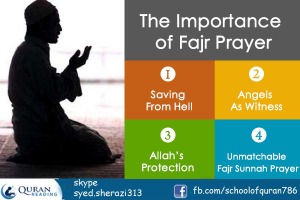
Saving From Hell:
At a general level, Muslims offer prayer to submit to Allah Almighty and to show that they are His subjects and they remember and worship Him only. Moreover, the offering of prayers is also something that pleases Allah Almighty and on those whom He is pleased, He showers His blessings on them in this world and in the world hereafter. As Prophet Muhammad (PBUH) said in one of His hadiths:
“Whoever performs the Prayer before the rising of the sun and the Prayer before its setting will not enter Hell.” (Muslim)
This hadith clearly states that among Muslims whoever offers the Fajr and Maghrib prayer will not enter Hell. The thing to consider in this regard is that one does not get expiated from Hell by offering a single Fajr and Maghrib prayer, rather one needs to do it with regularity. Therefore, once a Muslim makes offering of Fajr prayer a part of his or her life, it increases their chances of entering paradise and avoiding Hell.
Angels As Witness:
Another major reason why a Muslim must strictly observe offering of Fajr prayer is the fact that angels sent down by Allah Almighty witness the Fajr prayer offered by a Muslim. About this witnessing, firstly Allah Almighty says in Quran:
Establishing Fajr PrayerEstablish prayer at the decline of the sun [from its meridian] until the darkness of the night and [also] the Qur’an of dawn. Indeed, the recitation of dawn is ever witnessed.” (17:78)
The ayah clearly addresses Muslims to establish Fajr and Maghrib prayer, whilst mentioning that the prayer of Fajr is witnessed. This witnessing refers to the witnessing of angels about which Prophet Muhammad (PBUH) spoke in a hadith in the following way:
“There are angels who take turns in visiting you by night and by day, and they all assemble at the dawn (Fajr) and the afternoon (Asr) prayers. Those who have spent the night with you ascend to the Heaven and their Lord, Who knows better about them, yet asks, ‘In what condition did you leave My servants?’ They reply, ‘We left them while they were performing Salah and we went to them while they were performing Salah.’” (Bukhari)
From this hadith of Prophet (PBUH) it is clear that the angels who are sent down by Allah Almighty at night have to return to Him on the morning of the next day. When they reach the court of Allah Almighty and Allah inquires to them abut a particular subject, then these angels witness to that person performing the Fajr prayer. Therefore, a Muslim must try to offer the Fajr prayer on time so that the angels returning back to witness his or her prayer being offered which nonetheless ensures the entry to heaven by the Muslim.
Allah’s Protection:
There is no denying the fact that prayers is a means of invoking Allah Almighty. In this invocation a Muslim can ask Allah Almighty for anything, whether it is paradise, the expiation from sins or receiving of Barakah and so on. The one thing that Allah Almighty provides a Muslim without asking is His protection, regarding which Prophet Muhammad (PBUH) said in a hadith:
“Whoever prays the Fajr prayer, he or she is then under Allah’s protection. So beware, O son or daughter of Adam, that Allah does not call you to account for being absent from His protection for any reason.” (Muslim)
From the hadith it is clear that the one who offers Fajr prayer is directly under the protection of Allah Almighty. Therefore, if a Muslim wishes to spend the day in a way where he or she does not need to fear anyone, then offering Fajr prayer is a means of doing so at the beginning of the day.
Unmatchable Fajr Sunnah Prayer:
In each of the five times a day prayers, there are certain Sunnah prayers which a Muslim offers either before or after the obligatory prayer. These Sunnah prayer take their name after the traditions of Prophet Muhammad (PBUH) Who used to offer these prayers before or after the obligatory one. Out of the Sunnah prayers, there is none that is equal to the Sunnah prayer that is offered before the Fajr prayer. Regarding these Sunnah prayer, Prophet Muhammad (PBUH) said in a hadith:
“The two Sunnah cycles of prayer preceding Fajr prayer are better than this world and all that it contains.” (Tirmidhi)
From this hadith the importance of the Sunnah prayer before Fajr is clear and obvious. Moreover, the point to ponder that can be deduced from this hadith is that if the Sunnah prayer of Fajr have this much importance then how great would be the reward of the obligatory prayer. Thus, every Muslim must complement the Fajr obligatory prayer with the Sunnah rakats.
Quick Tips For Waking Up Early For Fajr:
There is no denying the importance of Fajr prayer, however, there are people who find it hard to wake up early for Fajr prayer. Some sleep late at night, some have long days ahead and so on, because of all which people find it hard to wake up on time for Fajr. In this regard, the following tips can help a Muslim:
  1. The first thing you can do is to set the alarm for the right time. If you turn the alarm to snooze mode a few times, then set the alarm accordingly so that the last time you turn it to snooze, you still have time to get ready for Fajr. Regarding that, you can install Find Qibla Direction application on your app which will automatically buzz on the specific timings of Fajr prayer according to your location.
  2. Secondly, it is a cliché but sleeping early at night really helps. Therefore, the earlier you sleep the easier it gets to wakeup for Fajr.
  3. Thirdly, if you think nothing works for you then there should be no shame in seeking the help of parents and peers who can wake you up at the time of Fajr.
Conclusion:
In short, other than the obvious rewards and benefits of offering Fajr prayer as discussed above, the offering of Fajr starts the day of a Muslim with the name of Allah and gives him or her the right foundation to have a righteous day that is spent under the blessings of Allah Almighty.

Do’s and Don’ts of A Muslim Women Dress Code

Do’s and Don’ts of A Muslim Women Dress Code
Dressing-Like-a-Muslim-Women copy
When it comes to the comparison of other religion of the world with Islam, the most important element that makes Islam supersede them all is the fact that Islam is a code of life. Other religions are only religions that speak of only the religious aspects of life, whereas, in Islam religion and Islam are integrated and they cannot be segregated and made isolated.
Islam gives code and instructions about each and every element of life, whether it be the social, environmental preservation, human rights, Quran tutoring and Teaching, economical guidelines or the living style of a Good Muslim. Pertaining to living style of people in general and women in particular, dressing is a major part of it.
Where Islam addresses the way men should dress, it also gives comprehensive instructions on how women should dress. The lines below discuss the major constituents of the dressing of women in Islam.
The Right Kind of Garment:
In Quran, Allah Almighty says:
Muslim Dressing Code
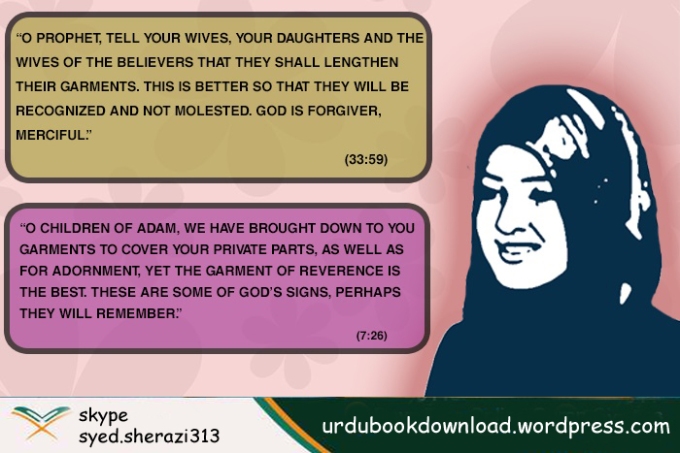
“O children of Adam, We have brought down to you garments to cover your private parts, as well as for adornment, yet the garment of reverence is the best. These are some of God’s signs, perhaps they will remember.” (7:26)
From this ayah of Quran it is evident that garments were given by Allah Almighty to mankind so that they could protect their private parts. Therefore, there is the option available for wearing any kind of dress that covers the private parts, however, in the same ayah Allah Almighty says that the garment of reverence is the best. Thus, if a women wears a particular dress then she needs to consider that whether or not the dress comes with decency.  Therefore, the prime object of dressing is to cover the private parts, however, it should be done with decency and modesty.
Covering Bosoms:
The detailed description of the kind of dress women should wear is explained in the Quran in the following way:
Muslimah Dressing Code
“And say to the believing women that they should lower their gaze and guard their modest; that they should not display their beauty and ornaments except what (ordinarily) appear thereof; that they should draw their veils over their bosoms and not display their beauty except to their husbands, their fathers…………….” (24:31)
From this ayah the first thing that becomes clear pertaining to dressing of women is that they should draw veils over their bosoms. The breasts of women are a private body part, therefore, in the light of previous ayah of Quran they need to protect it. Moreover, instead of revealing their bosom, women need to keep them under protection all the time. Hence, whether in public or in private with close people, women are not allowed to drop down the veil from their bosom, rather they need to stay covered. Therefore, whether it is a coat, a shawl, a scarf or any other form of cloak that covers the bosoms, it should be used in regular dressing of Muslim women.
Protection of Adornments:
The other necessary element or the objective, which the dressing of a Muslim woman must cover, is the protection of adornments. As described in the aforementioned ayah, Allah Almighty commends women covering their bosoms along with their adornments except the ones that are ordinarily visible. For women the general understanding of the adornments is the parts of the body of women that carry sexual connotations. Thus, Allah Almighty wants women to wear such dresses that does not reveal their adornments to other people. However, the other thing to observe and ponder about in this regard is that, Allah Almighty does not make the rule overly strict, rather it is allowed for women to have their face and hands uncovered as without them it becomes difficult for them to perform even the most trivial of jobs in daily life. Hence, the dress should be loose so that the adornments of women’s body are covered and they do not give any kind of sexual signals to the opposite sex.
Long Garments:
In Quran, Allah Almighty says:
Quran Says about Women Dressing
“O Prophet, tell you wives, your daughters and the wives of the believers that they shall lengthen their garments. This is better so that they will be recognized and not molested. God is Forgiver, Merciful.” (33:59)
The third important factor that women need to ensure in their dressing is the longer length of the dress. When the length of the dress covering the body is increased, it becomes quite natural that the dress hangs loose on the body. When it hangs loose on the body, it does not let the adornments or the bosoms of women get prominent, thus the purpose of dress is served. Therefore, in order to avoid attraction in general and exhibition of sexuality in particular, women should wear clothes with longer length that do not make the body parts prominent.
Avoiding See-through Garments:
As discussed above, the ultimate purpose of garments is to protect the private parts of the body of a woman. Therefore, it is of grave importance that women wear such clothes that are not see through. The clothes must not be see through, other than that women have a free hand when it comes to choosing the type and kind of dress they want to wear.
Conclusion:
In a nutshell, it is imperative that women wear such dresses that cover their private body parts in a way that there are neither visible to the people, nor do they standout when covered. In this regard, long and thick clothes can help achieve the purpose, or using a cloak over the clothes of desire to prevent one’s self from any kind unwanted attention or experience.

Wednesday, April 20, 2016

How to be Closer to Allah & Attain His Love


It is in human nature that when a person likes someone, it tries its best to say no word of offence in order to please that individual, like parents let go of most of the mistakes of their children because they love them. Same is the case of a true Muslim, who knows that the purpose of its presence in this world is solely to live according to the directions of Allah SWT, being closer to Him and gain His Affection. Abu Hurrerah (R.A) narrates the Holy Prophet (PBUH) saying as:

 “Verily Allah Ta’ala has said: ‘Whosoever shows enmity to a wali (friend) of Mine, then I have declared war against him. And My servant does not draw near to Me with anything more loved to Me than the religious duties I have obligated upon him. And My servant continues to draw near to me with nafil (supererogatory) deeds until I Love him. When I Love him, I am his hearing with which he hears, and his sight with which he sees, and his hand with which he strikes, and his foot with which he walks. Were he to ask [something] of Me, I would surely give it to him; and were he to seek refuge with Me, I would surely grant him refuge.” (Sahih Bukhari)

The above mentioned Hadith sheds light on advancing towards the Almighty Lord, and seeking His liking. First, it has been emphasized to accompany “Wali” (Friends of Allah), those who are already in close proximity with the Gracious God, and refrain from hostility to them in order to avoid the Wrath of the Most Powerful. It means that one should first escort and act upon the advices of true disciples of the religion of Islam, for they act a guiding path towards the attainment of Allah`s Qurb (amity) and keenness. One can also take help from obligatory and non obligatory actions in this regard. And there are great rewards from the Most Beneficent for such person in the form of Allah`s assistance in completion of one`s matters.

Attaining Allah love

Following are some of the Fard (compulsory) and Nafl (non compulsory) ways to achieve the Almighty`s Friendship and Love:

Fulfillment Of Religious Obligations

Muslims are required to perform certain sacred duties. These responsibilities include five major pillars of Islam, i.e. tawheed, Salah (prayers), fasting, zakah (charity) and Hajj (Pilgrimage), without which one cannot attain the much needed companionship of the Almighty.

1- Tawheed (Shahadah)

The foremost deciding factor to acceptance of Islam is completion of one`s faith by first considering Allah SWT as the Sole Creator of everything that is residing in this world and the entire universe, and also believing in the fact that Hazrat Muhammad (PBUH) is the Last Prophet of God, the Exalted. It also demands that one should avoid from committing Shirk (taking someone else as partner of God).

near to allah
It is You (Allah) we worship and You we ask for help. [Quran, 1:5]

This Ayah from Surah Fatiha (Chapter 1), which is a form of supplication for gaining the righteous path, shows that one can only attain the Almighty`s guidance in matters through execution of Tawheed. We Muslims recite this verse each time we offer the obligatory prayers, which are also great means of getting closer to the Creator of the world of the worlds.

2- Namaz (prayers)

Salah is the second most important religious action that we are ordered to perform five times a day. It`s a means of prostrating in front of Allah SWT, and asking for His Mercy and Blessings. During these prayers, a Muslim is in a state of standing right in front of God, and especially in the state of Sajdah (prostration), one is closest to the Almighty that it ever can try to.

Allah love
No! Do not obey him. But prostrate and draw near [to Allah]. [Quran, 96: 19]

In the above stated Quranic verse, the Almighty Lord is urging us to ask only from Him, so that we could be drawn near to Him.

3- Fasting

This act is solely meant for sake of Allah SWT and Muslims are obligated to carry out 30 consecutive Saum (fasting) in the holy month of Ramadan. During fasting, Muslims avoid eating, drinking, forbidden talking and other wicked activities, and in the end, they are able to receive Compassion and Bounties of the Gracious God. The Messenger (PBUH) of Allah once declared:

“Allah said: ‘Every deed of the son of Adam is for him except fasting; it is for Me and I shall reward for it…” (Bukhari and Muslim)

This Hadith e Qudsi describes the great reward from Allah Almighty to His servants for this action. As this deed keeps one away from all sinful activities so it automatically leads towards the attainment of closeness to God.

4- Zakah (charity)

The religious duty to take care of the poor people around oneself by sharing one`s surplus resources among them up to a certain limit. It ensures the stabilization of the society through mutual welfare.

attain love
“Your ally is none but Allah and [therefore] His Messenger and those who have believed – those who establish prayer and give zakah, and they bow [in worship].” [Quran, 5: 55]

It means that donating among the needy is one of the chief ways to gain the company of the Almighty Lord.

5- Hajj (Pilgrimage)

This sacred action which involves visiting and completing the Sunnah of Hazrat Ibrahim (A.S) to show one`s gratitude towards Allah SWT.

“And complete the Hajj and ‘umrah for Allah … And whatever good you do – Allah knows it.” [Quran, 2: 196, 197]

These Ayats tell us about the implication of this deed as it is done for sake of the Almighty, and His provision is granted for whoever performs it with true heart. The faithfulness shown to the Most Merciful leads towards closeness to Him, as He knows the exact intentions of deeds and the more we move towards Him, even more He moves towards us.

Carrying out Nafl (non obligatory) actions

The saying of the Holy Prophet (PBUH) under dialogue takes religious duties as the primary source of attaining closeness to the Almighty, and also  rates Nafl (non obligatory) actions very high for gaining the Love of Allah SWT. Nafl means “anything that comes as a bonus”. As supererogatory deeds are up to one`s own will to either perform or not, and they demand extra effort from an individual, so by executing them, one tends to get prominent among other Muslims, and gets additional blessings from God. The Messenger (PBUH) of Allah used to carry out such deeds on a regular basis, like praying Tahajjud Salah and Istikhara Supplication (Sunnah of Hazrat Muhammad PBUH) in later part of night which are deemed as the most useful ways of being near to the Most Gracious. It is narrated by Umme Habibah (R.A) that the Prophet (PBUH) has said:

“Any Muslim slave of Allah who prays for the sake of Allah 12 rakats every day other than the obligatory (prayers) Allah will build for him a house in jannah.” (Muslim)

Such is the great significance of these prayers that one gets eligible to enter the Jannah by offering them daily along with compulsory Namaz.

Understating the Holy Quran

The Sacred Book of Quran acts as a reminder for all of us about our purpose of existence on earth, direction for success in this world and hereafter through fulfillment of our religious and moral duties, solutions to many of our social and individual problems etc. So, by reading the verses of Quran, one gets enlightened regarding many issues that are means of accomplishment in the world and hereafter.

closer to allah almighty
And to recite the Qur’an.” And whoever is guided is only guided for [the benefit of] himself; and whoever strays – say, “I am only [one] of the warners. [Quran, 27: 92]

This Quranic verse elaborates the worth of understanding the Holy Book in a sense that it is a complete source of guidance. When one comprehends the basic theme of Islamic conviction, it ultimately results in closeness to the Almighty Lord, pleasing Him and shirking from the worldly pleasures.

So, to conclude, we can say that by fulfilling the requirements that are discussed above, we can attain the Companionship of Allah SWT, which results in execution of all our actions effectively, as the Almighty takes control of them and Helps us in their execution. And undoubtedly, His Company is Safest of them all, after which we no longer require to seek anyone else` assistance and protection. May Allah, the Exalted give us willpower and craving to seek His Comradeship through righteous deeds! Aameen!

Islamic Dress Code for Men – Major Elements to Consider

Islamic Dress Code for Men – Major Elements to Consider
Although one needs to see the inner beauty and character of a person to reach some judgment about the person, however, this does not mean that one should ignore the physical appearance of a person at all. The way a person looks from the outside is that gives the first impression about what a person is like or from which place or school of thought a person belongs to.
When it comes to physical appearance in general and dressing in particular, Islam gives clear instructions about how both the genders dress, so that they do not break the rules of Islam and in their dressing there is modesty. In addition to women, Islam has also spoken about the way Muslim males should dress.

The lines below give the general Islamic instructions pertaining to male dressing.
Avoid The Haram Elements:
Although in Islam there is great freedom to Muslim in terms of wearing the kind of dress they like to wear, however, there are some limits which should not be crossed by a male Muslim. In this regard, a Muslim is not supposed to wear gold and silk in part of dressing or the whole attire. Regarding this, Prophet Muhammad (PBUH) said in His hadith:
“These two (gold and silk) are forbidden for the males of my ummah and permissible for the females.” (Ibn Majah)
From this hadith of Prophet Muhammad (PBUH) it is clear that both silk and gold are Haram and impermissible to Muslim men, therefore, they need to avoid the dressing which includes these two elements. If these two elements are present in the dressing, then the dressing will be Haram and against the teaching of Islam. Other than that, Muslims can wear any dress made out of skin of animals, their fur or the stuff made out of them.


Avoid See-through Dresses:
The second thing that Muslim men need to avoid in their dressing is the see through dresses. When the dresses are see through the ultimate result of it wall will be people being able to see the Aurah (the mandatory covering region). Hence when the Aurah of a person becomes visible, it is counted in the category of sin. Therefore, in order to avoid any such situation, Muslim men should refrain from wearing see through garments, until and unless they are wearing some kind of undergarment that protects their Aurah.
Avoid Imitation:
It is narrated that once Prophet Muhammad (PBUH) saw Hazrat Ali wearing two garments that were dyed with safflower, seeing which He said:
“These are the garments of Kuffar, do not wear them.” (Muslim)
From this ayah it becomes clear that a Muslim is not supposed to copy the non-Muslims when it comes to wearing of dress.  The dress of a person is a part of his identity, therefore, when one starts copying the non-Muslims in dressing, it means that the person is prone to accepting their values as well and losing his own Muslim identity. Therefore, for this very reason, a Muslim must avoid imitating the non-Muslims with regards to the type and kind of dressing worn.
Avoid Women Dressing:
In addition to refraining from gold and silk, Islam also instructs its followers to avoid dressing like women. It is quite evident that there is a difference between the way women dress and the way men dress, therefore, to keep things simple and to avoid any kind of awkward situation, a Muslim must refrain from dressing like women. In this regard, Prophet Muhammad (PBUH) said in His hadith:
“Cursed be the men who imitate women and the women who imitate men.” (Bukhari)
Therefore, men must avoid imitating women in dressing and similarly women must avoid imitating men in their dressing. Checkout the Islamic dress code for Muslim Women.
Start From The Right:
In addition to the apparel, Prophet Muhammad (PBUH) has also spoken about the way a Muslim should start wearing a dress. In addition to starting wearing the dress with Bismillah (In the name of Allah) a Muslim must start wearing the dress from the right side. Regarding this, Prophet (PBUH) said in a hadith:
“When you get dressed and when you do wudoo, start on the right.” (Abu Dawood)
Hence, a Muslim must try wearing the dress with the right side first and then moving on to the left part of the attire.
Avoid Arrogance:
In the world of today, the dressing of a person has become a status symbol. Although Islam emphasizes on wearing clean and pleasant clothes and having modest dressing, however, it condemns the element of arrogance associated with it. Prophet (PBUH) said:
“No one will enter Paradise in whose heart is a mustard-seed of arrogance.”
The companion asked:
“What if a man likes his clothes to look nice and his shoes to look nice?”
Prophet (PBUH) replied:
“Allah is beautiful and loves beauty; arrogance means rejecting the truth and looking down on people.” (Muslim)
Therefore, if the dressing is worn with the objective of making oneself superior and to make other people think that they are inferior, then it is strongly prohibited in Islam, whereas, if it done for the purpose of looking beautiful, whilst being modest, then such dressing is allowed in Islam.
Above Ankle:
Another important thing that Muslim men need to ensure in their dressing is the fact that their lower garment should be above their ankles. It means that the pants part of the dress should be above ankles. In this regard, Prophet Muhammad (PBUH) said:
“Whatever of the lower garment is beneath the ankles is in the Fire.” (Bukhari)
This hadith of Prophet (PBUH) is specific to males, therefore, it is imperative that Muslim men avoid any such garment that hangs loose below the ankle length.
Conclusion:
In a nutshell, the aforementioned are the major elements that Muslim men must ensure in their dressing. The presence of these elements gives them a Muslim identity and makes sure that they are as Muslim in their appearance as they are at their hearts.

adfly

Listen to Quran

TvQuran